Off the Grid and On Two Wheels: Inside the Rider Networks Building Their Own Rules
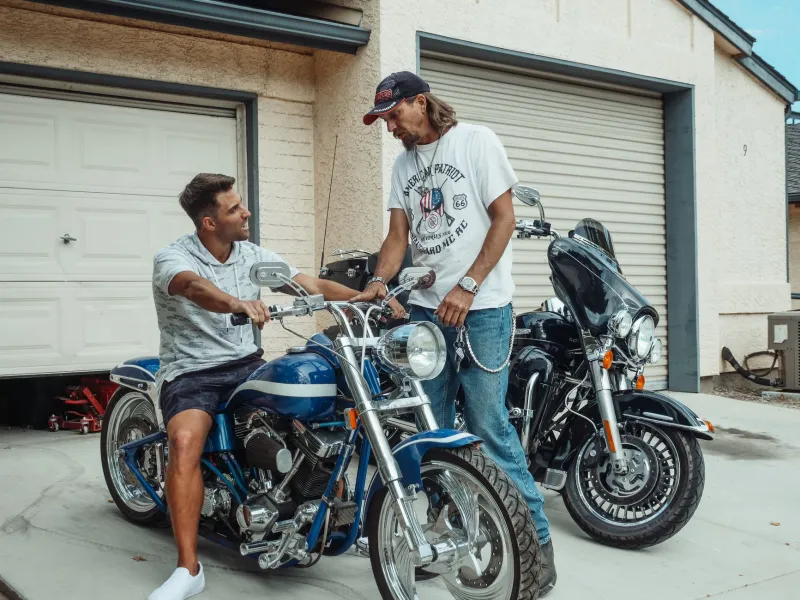
Somewhere in the Pacific Northwest, a group of about forty riders operates a shared parts pool that's been running for six years without a single formal contract. Members contribute components, pull what they need, log the transaction in a shared spreadsheet, and settle up at the annual meet. No LLC. No terms of service. No corporate oversight.
It works because everyone in the group knows each other, or knows someone who does. Trust is the infrastructure.
This kind of arrangement isn't unusual in the custom motorcycle world. What's unusual is how few people outside it know it exists.
Why Riders Are Building Parallel Systems
The friction starts with insurance. Standard motorcycle insurance policies are built around production bikes with known specifications, predictable parts costs, and manufacturer-approved configurations. Radical customs — bikes with fabricated frames, heavily modified engines, non-standard dimensions — are a nightmare for underwriters who depend on standardized risk models.
Many custom builders and owners have run into the same wall: carriers either refuse coverage outright, offer policies with exclusions so broad they're nearly meaningless, or price the coverage so high it's financially irrational. For a bike that cost $30,000 to build and is ridden 2,000 miles a year, paying $4,000 annually for coverage that might not actually pay out on a claim is a hard sell.
So riders have started finding other ways.
"The insurance thing is where a lot of people start," says a builder in the Southeast who asked to be identified only by his shop name. "Once you realize the system wasn't built for what you're doing, you start looking around for alternatives. And you realize other people already figured this out."
Peer-to-Peer Coverage: How It Actually Works
The peer-to-peer insurance arrangements operating within riding communities aren't technically insurance in the legal sense — and that distinction matters. What they are, in most cases, is a structured mutual aid agreement among a defined group of riders.
The mechanics vary, but the basic model is consistent: members contribute a set amount — often monthly or annually — into a shared fund administered by a trusted person or small committee within the group. When a member has a loss, the group evaluates the claim informally and votes on a payout. The process is relationship-based, not actuarial.
This works best in tight-knit communities where reputation is currency. A member who files a sketchy claim doesn't just lose the payout — they lose standing in a community they depend on. That social consequence is more powerful than any legal deterrent in a formal insurance framework.
The obvious limitation is scale. These arrangements work for specific damage scenarios and relatively modest amounts. They're not a substitute for liability coverage on public roads, and most participants maintain some form of conventional liability policy for street riding. What the peer system handles is the stuff conventional policies don't — the custom parts, the fabricated components, the modifications that make a bike worth owning but also make it uninsurable by standard means.
The Closed Parts Network
The parts side of this parallel economy is arguably more developed than the insurance piece — and it's been running longer.
Closed-group parts networks operate across platforms like private Facebook groups, Discord servers, and old-school email lists. Membership is by referral only. The inventory is whatever members have — new old stock, pulled parts, fabricated components, sourced-but-surplus hardware. Prices are negotiated between members, often well below market rate, because the transaction cost is low and the trust is high.
For builders working on obscure platforms or vintage machines, these networks are often the only reliable source for specific components. A guy in Ohio who's been hoarding NOS Harley ironhead parts for twenty years is a more valuable resource than any online retailer, and the closed network is how you find him.
The vetting process for entry varies by group. Some require a sponsor who's been a member for a minimum period. Others require a track record — documented builds, event attendance, known participation in the broader community. The common thread is that anonymity is disqualifying. You need to be a known quantity.
Informal Safety Certification Among Trusted Builders
Perhaps the most interesting development in this parallel ecosystem is the emergence of informal safety certification — a community-based process for validating that a custom build is roadworthy, operating entirely outside any official inspection framework.
This isn't universal, and it's not standardized. But in certain communities, particularly those centered around performance-oriented builds or long-distance riding, it's become a real practice. A builder brings a finished bike to a trusted peer — someone with fabrication experience and a reputation for thoroughness — for a walk-around evaluation. The peer checks welds, brake function, steering geometry, electrical integrity. They give a thumbs up or they don't.
No paperwork. No certification body. Just the judgment of someone whose opinion the community respects, and the social accountability that comes with putting your name behind a bike.
"It's honestly more rigorous than a state inspection in a lot of cases," says one builder who participates in this kind of peer review regularly. "A state inspector is looking for compliance with a checklist. The guys in my network are looking at whether I'd want to ride this bike at speed. That's a different standard."
What This Reveals About the Broader Culture
The parallel systems thriving inside the custom motorcycle community aren't anti-establishment for the sake of it. They exist because the establishment genuinely doesn't have good answers for what these riders are doing.
The insurance industry isn't equipped to price radical custom risk fairly. The parts distribution system isn't designed around low-volume, high-specificity demand. Official safety inspection frameworks weren't written with fabricated-frame customs in mind.
So riders built their own answers — rooted in trust, reputation, and mutual accountability. The result is a remarkably functional economy operating in the spaces the mainstream can't reach.
For anyone outside the community looking in, the lesson is worth taking seriously. When institutions fail to serve a group, the group doesn't disappear. It gets creative. And sometimes the system it builds is better than the one it replaced.