When the Parts Don't Play Nice: Surviving the Chaos of a Mismatched Custom Build
Every great custom build starts with a vision. Sometimes that vision is a clean, cohesive concept that flows naturally from frame to fender. And sometimes — more often than anyone in the community likes to admit — it's a fever dream stitched together from a swap meet haul, three eBay wins, and a friend-of-a-friend's barn find. The result? A bike that looks like it should work, right up until the moment it absolutely doesn't.
Call it the mismatched build problem. Call it a frankenbike. Whatever you call it, veteran techs across the country are dealing with these mechanical identity crises on a weekly basis, and the hidden costs — in time, money, and sanity — go a lot deeper than most first-time builders anticipate.
The Romance of the Mix-and-Match
There's a reason mixed-era builds are so appealing. The aesthetic contrast of old and new is genuinely compelling. A pre-unit Triumph engine sitting inside a modern hardtail frame? Visually striking. A vintage Shovelhead dropped into a contemporary rigid with billet controls? That's a look that turns heads at any show. The problem isn't the idea. The problem is execution — and more specifically, the gap between what a builder thinks will work and what physics, metallurgy, and decades of design evolution actually allow.
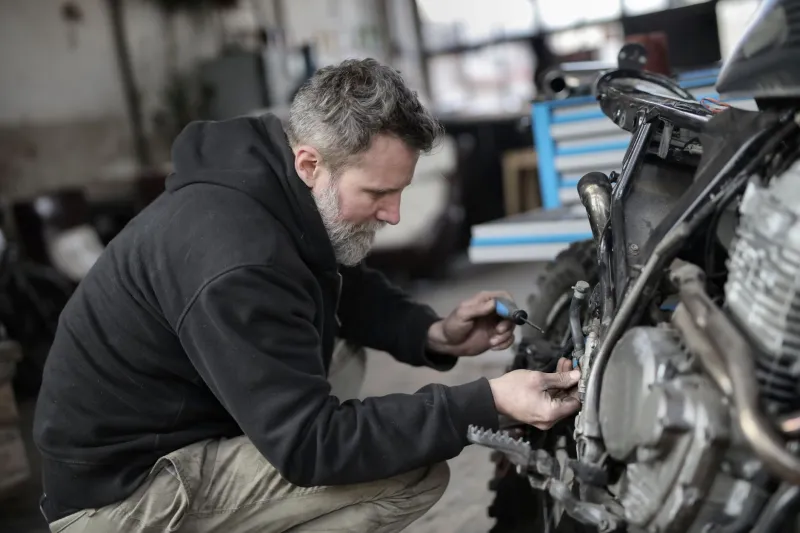
"I see it constantly," says Marcus Delray, a fabricator and tech out of Columbus, Ohio, who's been wrenching on customs for going on 22 years. "Guy comes in with a killer concept, legitimate vision, and then you start pulling apart what he's got and realize the motor mounts are off by an inch and a half, the electrical systems are from completely different eras, and nobody thought about where the exhaust was going to exit. Now we're rebuilding half the bike before we even get to the fun stuff."
Delray's experience is far from unique. Across the US, independent shops report that a significant chunk of their custom work isn't building from scratch — it's untangling someone else's ambition.
Where It All Falls Apart
So what are the most common failure points? Experienced builders and techs point to a handful of recurring culprits.
Motor mount geometry is almost always the first fight. When a frame was designed for a specific engine family, the mounting points, the angle of the powerplant, and the overall center of gravity were calculated together. Swap in a different engine — even one from the same manufacturer but a different decade — and those calculations go out the window. The result can be anything from awkward aesthetics to genuine handling problems once the bike is rolling.
Electrical incompatibility is the second major headache, and it's one that catches a lot of builders off guard. A vintage engine running points ignition doesn't play well with a modern wiring harness built around electronic fuel injection logic. "People underestimate how much of modern bike design is electrical," notes Sandra Krupp, a tech and custom builder based out of Austin, Texas. "You can't just splice old into new and hope for the best. The systems speak different languages."
Transmission and primary drive mismatches round out the top three. Pairing an engine with a gearbox it was never designed to talk to requires custom adapter plates at minimum — and often a complete rethinking of the primary drive setup. Each adapter, each workaround, adds cost, adds potential failure points, and adds time.
The Budget Bleed Nobody Talks About
Here's the thing about mismatched builds that the Instagram highlight reel doesn't show: the money doesn't stop at the parts list. It keeps going.
When you're working outside the bounds of what any manufacturer or aftermarket supplier designed for, you're often paying for custom fabrication at every turn. That adapter plate for the transmission? Someone has to machine it. That exhaust that clears the relocated engine? Someone has to bend and weld it. Those motor mounts that don't quite line up? Someone has to build new ones from scratch.
"I had a customer come in last spring with what he thought was a $3,000 problem," Delray recalls. "By the time we got the engine sitting right, the primary sorted out, and the electrical system functional, he was closer to $11,000 deep. And that didn't include paint or finishing work. It's not that anyone was padding the bill — it's just that every fix revealed another fix underneath it."
That cascading cost structure is the silent killer of ambitious builds on tight budgets. The initial parts acquisition feels like a win. The real expense comes when you're trying to make those parts coexist.
How the Pros Navigate It
So how do experienced builders avoid the worst of it? A few strategies come up consistently in conversations with veteran fabricators.
Research the donor bikes first. Before you commit to a frame-and-engine combination, find out if anyone else has done it. The custom community is generous with information, and forums like The Jockey Journal or V-Twin Forum often have build threads documenting exactly what problems came up and how they were solved. If nobody has documented that pairing, that's a warning sign worth heeding.
Budget for the unknowns explicitly. Krupp recommends adding a 40 percent contingency to any mismatched build estimate. "It sounds aggressive until you're three months in and you've already blown through your original number," she says. "The 40 percent buffer isn't pessimism. It's just honesty about how these builds go."
Know when to call it. This is the hardest one for enthusiastic builders to hear, but sometimes a combination just isn't worth the fight. If making two components work together requires more engineering than the build is worth — financially or mechanically — there's no shame in pivoting. Swapping to a more compatible donor, or adjusting the frame choice, can save months of headaches.
Lean on the community. This is where being plugged into the real riding and building community pays off in a practical sense. A builder who's already cracked a specific compatibility problem is usually willing to share what they know. That knowledge can save you thousands.
The Builds That Make It
None of this is meant to scare anyone off the idea of a mixed-era build. Some of the most celebrated customs in the country are exactly these kinds of marriages — unexpected combinations that required serious ingenuity to pull off. The difference between those bikes and the ones that end up as cautionary tales usually comes down to preparation, patience, and realistic expectations about what the process is going to cost.
The frankenbike failures that end up in shops aren't usually the result of bad ideas. They're the result of underestimating the gap between concept and execution. When you know that gap is there — when you plan for it, budget for it, and respect it — a mismatched build stops being a nightmare and starts being exactly the kind of challenge that makes custom building worth doing in the first place.
Just go in with your eyes open. And maybe add a few grand to that parts estimate.